
European industry is undergoing a period of accelerated transformation. Regulatory pressure, the need to reduce dependence on fossil-based raw materials, and the search for more sustainable production models are forcing industries to redefine how industrial materials are designed, manufactured, and recycled.
In this context, bio-based composites are no longer simply a promising research field; they have become a real alternative with strong industrial application potential. However, their large-scale implementation still presents significant technical challenges related to dimensional stability, processability, traceability, and recyclability.
Bio-Uptake was created precisely to address these challenges. Funded by Horizon Europe, the project brought together companies, technology centers, and research organizations with a common goal: to demonstrate that bio-based materials can be integrated into advanced industrial processes while maintaining competitive performance and supporting circular manufacturing models.
At Aitiip, we actively participated in this initiative as coordinators, working on the development of new advanced biopellet formulations for overmolding processes, as well as on the optimization of processing technologies aimed at improving the efficiency and industrial quality of biocomposites.
Beyond the results achieved, Bio-Uptake demonstrated that combining material innovation, industrial digitalization, and circular economy strategies can accelerate the transition toward more sustainable manufacturing in Europe.
Bio-Based Composites and Circular Economy in European Industry
The transition toward sustainable production models is no longer only about reducing emissions or improving energy efficiency. Increasingly, industrial sectors need materials capable of lowering environmental impact without compromising mechanical performance, durability, or economic viability.
Bio-based composites are composite materials manufactured partially or entirely from renewable resources, designed to reduce environmental impact and support circular manufacturing models.
In this context, bio-based composites are gaining increasing attention in sectors such as packaging, construction, automotive, and medical applications. Their ability to combine lightweight properties, strength, and recyclability potential makes them especially attractive for industrial strategies aligned with the European Green Deal.
But why has their industrial adoption been so difficult until now?
Although many bio-based solutions offer environmental advantages, they have historically faced limitations related to:
- Excessive shrinkage during processing
- Moisture sensitivity
- Thermal instability
- Difficult integration into existing industrial lines
- Complexity in recycling processes
One of Bio-Uptake’s main objectives was precisely to address these issues through a holistic approach, simultaneously working on materials, processes, digitalization, and circularity.
Bio-Uptake: European Innovation in Bio-Based Composites and Sustainable Manufacturing
Unlike projects focused exclusively on laboratory research, Bio-Uptake aimed to validate technologies in real industrial environments.
The project worked across the entire value chain of sustainable composites and circular materials for industry:
- Development of sustainable industrial materials
- Optimization of industrial bioplastics
In addition, the project covered everything from advanced raw material development to industrial demonstrator manufacturing, including process simulation, artificial intelligence applied to quality control, smart monitoring, and recyclability strategies.
This approach generated tangible results in multiple areas.
For example, CENTEXBEL significantly improved the dimensional stability of PLA yarns intended for composite applications, reducing material shrinkage while simultaneously increasing mechanical resistance. This advancement is particularly important because deformation during processing is one of the main barriers to the industrialization of bio-based materials.
The project also validated new PLA fabrics for medical applications, later used in the manufacturing of fully bio-based plantar orthoses.
The relevance of these developments lies not only in the material itself, but in demonstrating that biocomposites can meet demanding functional requirements in real applications.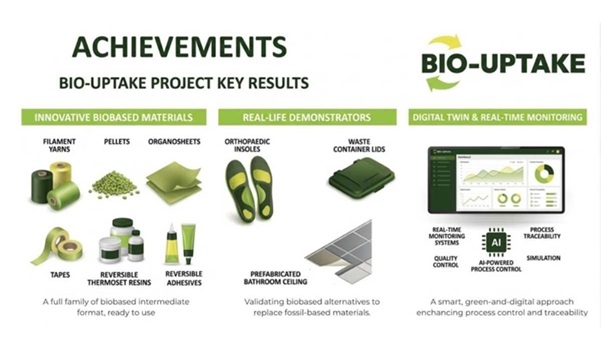
Aitiip’s Role in the Development of Advanced Biocomposites
Within the consortium, Aitiip focused its work on the development and validation of new biopellet formulations for overmolding processes.
The developed formulations were based on bio-based PA1010 combined with different reinforcement types, including recycled carbon fiber and wood fiber.
The objective was twofold: to improve the mechanical performance of the materials while facilitating their integration into more sustainable industrial processes.
To achieve this, advanced mechanical characterization under different thermal conditions was required. This stage is critical in any biocomposite industrialization strategy, as it allows a deeper understanding of material behavior during processing and helps anticipate potential deviations related to dimensional stability, stiffness, or thermal performance.
Reliable characterization data also facilitates process simulation and significantly reduces the industrial risk associated with introducing new materials.
In addition to material development, the project also focused on optimizing pellet conditioning through the incorporation of a hot-air drying conveyor system.
This solution eliminates the use of water during cooling and minimizes moisture absorption, one of the factors that most strongly affects injection molding quality in bio-based materials.
Improved moisture control increases process stability, enhances surface finishing, and supports more repeatable industrial-scale production.
Is Real Circular Economy Possible for Composites?
One of the historical challenges of composite materials has been recyclability.
Many conventional composites present major difficulties when it comes to separating materials, repairing components, or reintegrating waste into production processes. Bio-Uptake addressed this issue through different technological approaches.
Among the most relevant developments was the creation of reversible adhesives based on Diels-Alder chemistry. These solutions maintain strong bonding during the product’s service life while enabling easier separation through thermal activation.
As a result, multilayer or multimaterial components can be more easily disassembled at end-of-life, facilitating material reuse and recycling.
The project also advanced the development of reprocessable, repairable, and recyclable epoxy resins with bio-based content, expanding circularity opportunities in thermoset applications.
These solutions are particularly relevant in sectors where composite recyclability has traditionally represented a technological and economic barrier.
Industrial Digitalization and Intelligent Process Control
The industrialization of new sustainable materials does not depend solely on chemical formulation. It also requires digital tools capable of reducing uncertainty, optimizing processes, and ensuring repeatability.
For this reason, Bio-Uptake integrated several simulation, artificial intelligence, and advanced monitoring technologies.
SIMCON developed injection simulation models capable of predicting material behavior during processing. These tools significantly reduce the number of physical trials required to optimize manufacturing parameters.
Advanced simulation is especially valuable for bio-based materials, where small variations in temperature, moisture, or viscosity can significantly affect final product performance.
At the same time, AIMEN developed artificial vision systems based on neural networks to automatically detect defects in overmolded components.
These solutions enable real-time identification of filling problems, structural defects, or pressure deviations, improving quality control and reducing waste.
In addition, IRIS Technology Solutions developed monitoring technologies using infrared spectroscopy, hyperspectral imaging, and advanced thermography to control critical processing parameters.
The combination of sustainable materials and industrial digitalization represents one of the key transformation drivers for advanced manufacturing in Europe.
Industrial Demonstrators: When Biocomposites Leave the Laboratory
One of the most important aspects of Bio-Uptake was the industrial validation of the developed technologies.
The project successfully demonstrated the feasibility of real applications in strategic sectors.
In the medical sector, COMFIL manufactured a fully bio-based plantar orthosis through an optimized pressing process that reduced production times by approximately 50% compared to conventional technologies.
This result demonstrates how recyclable composites and sustainable materials can be integrated into advanced medical applications while maintaining demanding functional and production requirements.
In packaging, MOSES Productos developed a container lid based on PLA laminates and bio-based polyamide that combines lightweight structure, mechanical resistance, and reversible disassembly.
Meanwhile, CIDETEC validated recyclable construction panels using flax fibers and recyclable epoxy resins with high bio-based content.
These demonstrators reflect a significant shift in the evolution of sustainable composites: they are no longer merely experimental materials, but solutions with real industrialization potential.
How Bio-Based Composites Are Driving Sustainable Manufacturing in Europe
The results of Bio-Uptake demonstrate that combining material innovation, advanced manufacturing, and circular economy strategies can accelerate European industrial transformation.
The evolution of bio-based composites no longer depends solely on developing new sustainable materials. It also requires integrating sustainable Industry 4.0 solutions capable of optimizing processes, reducing waste, and ensuring traceability throughout the manufacturing chain. The real challenge now is integrating these materials efficiently into scalable, digitalized, and economically viable industrial processes.
In this context, collaboration between industry, technology centers, and European projects will remain essential to reducing adoption barriers and accelerating the market deployment of these technologies.
At Aitiip, we believe initiatives such as Bio-Uptake are essential to consolidating a more resilient, competitive, and sustainability-aligned industrial model in Europe.
The transition toward circular manufacturing is already underway, and advanced biocomposites will play a decisive role in that transformation.
Horizon Europe projects such as Bio-Uptake are demonstrating that combining material innovation, industrial digitalization, and circular economy strategies can accelerate the adoption of sustainable composites in strategic sectors across Europe.