
Every February 11, the International Day of Women and Girls in Science invites us to examine scientific progress from a broader and more inclusive perspective. It is not merely a symbolic date. It is an opportunity to assess how research evolves when talent is given the space and structure it needs to develop.
Science advances through data, methodology and critical thinking. But it also advances through role models. Through real stories. Through professional trajectories that demonstrate that scientific vocation is not defined by gender, but by curiosity, rigor and perseverance.
Listening to those who work daily in applied R&D helps us understand why this day continues to matter.
Visibility as a Starting Point
Leyre Hernández, PhD in Physics, expresses it clearly:
“I believe the International Day of Women and Girls in Science is necessary to give visibility to women scientists who did not receive recognition in their time and to create role models today.
Science gives us tools to solve problems and teaches us to be methodical.”
Visibility is not a symbolic issue. It is structural.
The Women in Science – Fact Sheet No. 60 (UNESCO Institute for Statistics, 2023) confirms that women represent approximately 33% of researchers worldwide. Although female participation has increased over recent decades, representation remains uneven in certain STEM disciplines and at senior levels of the research career.
UNESCO also highlights the decline in female representation at advanced career stages, a phenomenon known as the leaky pipeline. It is not a matter of capability. It is a matter of context and structural conditions.
This is why the International Day of Women and Girls in Science remains relevant: because visibility is the first step toward consolidation.
When Science Expands Horizons
Marta Redrado Notivoli, PhD in Chemical Industrial Technical Engineering, connects visibility with the next generation:
“Why is the International Day of Women in Science important? So that girls and young women are aware of all the possibilities available to them and of the remarkable achievements of women scientists.”
She adds:
“For me, science has opened the door to an extremely broad field. It is not only about what you study; by pursuing a scientific career, a vast range of professional, personal and cultural opportunities unfolds before you.”
That “range of opportunities” is also reflected in European data.
The official report She Figures 2024 – Gender in Research and Innovation (Publications Office of the European Union) shows that women account for nearly 48% of doctoral graduates in the European Union. However, their presence declines in senior academic positions and leadership roles in strategic R&D projects.
In Spain, the Statistics on R&D Activities (INEbase – National Statistics Institute) place female representation at around 41% of research personnel.
Access is progressing.
Leadership continues to evolve.
Inspiring and Transforming Scientific Culture
Eva Gavín Nogués, Industrial Engineer, summarizes it naturally:
“I believe it is important because it provides visibility, inspires, and tells other women that this path is also for them — that you do not need to fit into a stereotype to belong here.”
She continues:
“For me, science means learning every day, connecting ideas, projects and people to achieve real solutions.”
The connection between diversity and innovation is supported by international evidence. The OECD, in Bridging the Gender Gap in Innovation – OECD Science, Technology and Innovation Outlook 2023, notes that reducing the gender gap in science and innovation improves innovative performance and strengthens economic competitiveness.
Diversity is not a complementary factor. It directly influences the quality of solutions.
Structured Thinking: The Core of Applied Research
Raquel Navarro Miguel emphasizes the methodological dimension:
“Science has taught me to think critically and in a structured way, enabling me to face each challenge with determination.
That is why having role models is so important: there are still too few visible women in science, and giving them a voice inspires new generations and recognizes the value of their achievements.”
Critical and structured thinking lie at the heart of R&D.
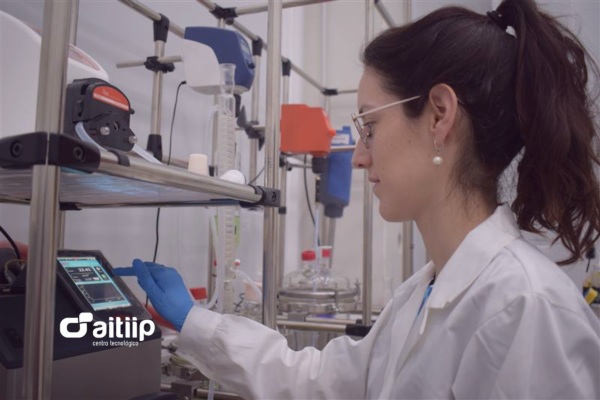
In a technological center such as Aitiip, where applied research connects scientific knowledge with industry, this structured mindset translates into technical solutions, process optimization, and effective technology transfer.
Female representation strengthens this methodological architecture.
Resilience: The Less Visible Dimension of Progress
Laura Nadal Calvo offers a deeply human perspective:
“Science taught me to overcome frustration and to become stronger. I realized that applied science is my path, and today I work in this field.”
Research involves constant iteration: testing, failure, adjustment, and improvement.
The She Figures 2024 report confirms that while female participation is significant at early stages, disparities persist in senior and decision-making positions.
Individual resilience is essential.
Organizational structure is equally decisive.
When Equality Becomes Scientific Efficiency
Carolina Peñalva Lapuente broadens the perspective:
“Celebrating this day is essential to provide visibility to real role models, showing girls that they can lead research projects in R&D departments within companies, universities, or technological centers such as Aitiip. We need future scientists to see that their curiosity has a place where it can transform into real solutions for the planet. It is fundamental because science cannot afford to ignore the talent of half of the population.”
She adds:
“For me, science is the ultimate tool to understand the ‘why’ behind everything around us. It is how I process reality: always searching for the origin, optimizing processes, and trusting in the value of data.”
Ignoring talent reduces scientific efficiency.
Integrating it strengthens innovation.
Beyond February 11: The Future Already in Motion
The International Day of Women and Girls in Science does not end when the day concludes. It is part of a continuous process of consolidating talent in global research.
That future is being built in laboratories.
In R&D departments.
In technological centers.
In projects that transform knowledge into real-world solutions.
At Aitiip, applied research integrates diversity of perspectives, critical thinking, and effective technology transfer. Scientific dissemination and technical publications are part of that responsibility.
But that future is already underway.
It is reflected in Leyre’s methodological precision.
In the broad horizon described by Marta.
In the inspiration championed by Eva.
In Raquel’s structured reasoning.
In Laura’s resilience.
In Carolina’s systemic conviction.
Science does not advance by inertia. It advances through talent.
And talent, when supported by structure, methodology, and an enabling environment, becomes transformation.
Sustainable innovation.
Technological development.
Shared progress.
Because diverse science is not only more inclusive.
It is, quite simply, better science.